Share |
The truths they don't want you to read....
Showing posts with label KIMO. Show all posts

Monday, December 31, 2007

Unidentified Floating Object

Coors Stinky Bay BenbeculaThe mysterious object found on the shore at the well named Stinky Bay, in Benbecula, has turned out to be an empty brewing vessel for Coors which was being shipped from Germany to the US.

So far so interesting, and it makes a nice story for the press to cover at what is normally a quiet time of year.

The question we should be asking is "Who is going to pay for it's disposal?"

The answer is: the Comhairle.

At present neither the shipowner, the customer, nor the supplier have any responsibility for anything lost overboard (although they can be liable for losses caused by the flotsam) and aas a consequence, once it is off the ship, nobody cares about recovery, removal or cleaning. Except the local authority who have to do the clean-up.

Last year, there was a proposal to add responsibility for losses from ships inside the EU back onto the shipowner (and they would presumably provide loss insurance for the customers), to ensure that funding for beaches and seas to be cleaned could be simple and clear.

Unfortunately, the UK (egged on by the shipping industry) vetoed this proposal, and the opportunity to pass this into law was lost. All of which explains why the shipowners never notified the Coastguard (or Lloyds?) of the loss - when, where, how? - as they have no obligation to do so. Indeed, doing so might create an obligation on them.

If we want to legislate against dropping litter on streets, why do we allow this kind of fly-tipping to continue?

Friday, November 09, 2007

Going bananas

Bananas on the beachThe residents of Terschelling, a small island off the coast of the Netherlands, awoke to find their beaches littered with unripe bananas, as the photo shows.

Yet another cargo ship had lost containers overboard, these had obviously burst, and the contents had washed up on the beaches. Previously the islands have had a large number of other products appear from broken containers.

It was these experiences that persuaded KIMO to demand that EU Ministers create a protocol for liability by shipowners in the event that cargoes are lost overboard. The expectations were clear: shipowners carry insurance for the clearing up of the beaches should containers be lost, and they charge the customers accordingly.

I argued for this at the Council of Ministers of the North Sea Convention, but the shipowners - vociferously aided and abetted by the UK - vetoed any such proposal.

The end result is that the shores of the Western Isles remain exposed to cargoes being lost due to bad weather or bad luck and these washing up on our coast to pollute it.

The cost would be borne by you and I, and whilst in theory it could be recovered from the shipowner, in practice this involves a number of tax havens, flags of convenience and teams of very expensive lawyers denying any responsibility for their client whilst blaming another.

Luckily, we have escaped so far, but who is to say it will be something as innocuous as bananas next time.

Friday, October 05, 2007

Single Hulled ex Ferry Sets Sail for Sellafield with an Ultra Hazardous Radioactive Cargo

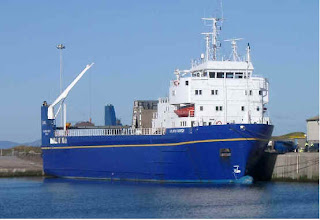
Atlantic Osprey - a nuclear ferryThe Atlantic Osprey an ex roll on roll off cargo vessel will depart Nykoping, in Sweden, on the 5th October carrying shipment of 4.8 tonnes of ultra hazardous spent nuclear fuel, containing Plutonium, for Sellafield in the UK to be reprocessed in the B205 Magnox plant. The use of this vessel which is single hulled, single engined, unescorted and already has had one engine room fire is unacceptable. It puts at risk the marine environment and the millions that live along the shipping route which route transverses some of Europe’s busiest shipping lanes and most dangerous waters

KIMO International has been calling for many years for such shipments to be halted and for the wastes to be dealt with at the site where they were produced. However where this is not possible, for safety reason, transports should be carried out with the Best Available Technology (BAT). The ex ro-ro ferry vessel the Atlantic Osprey, INF2 class, not only doesn’t represent BAT it doesn’t even represent the Second Best Available Technology.

Yet again coastal communities are being treated as third class citizens by their own governments. At last years North Sea Ministerial meeting in Göteborg Ministers refused to agree on the use of best available technology for these shipments and refused to review their marine national contingency plans for nuclear pollution.

At KIMO’s International Conference in Gorey, Co. Wexford, Ireland, on Friday 5th October a presentation will be given by Marine Nuclear Expert Tim Deere Jones on the deficiencies in the vessels and the risks associated with transports of just the type proposed to set sail for Sellafield.

As well as presenting a threat while it is transported this cargo of ultra hazardous spent fuel will also lead to an increase in emissions in to the Irish Sea and beyond during reprocessing at Sellafield. Then MOX fuel will have to be transported back to Sweden, along with some of the radioactive waste generated during reprocessing, doubling the risk of an incident. A KIMO International spokesperson stated,

KIMO remains convinced that the transport of nuclear materials should be halted and that such materials should be stored at the point of production. However should these shipments go ahead governments should be insisting that the highest standards of ship and security arrangements are in place to protect their citizens.

This means that the Best Available Technology (BAT) should be applied to the ships and flasks used in European shipments and should be at least to the same standard to the ships that are used for MOX shipments to Japan. The arrangements surrounding this proposed shipment are flawed and second rate. We are asking governments to take national action to ensure that their national pollution and security plans take into account a nuclear accident near the coast and that these shipments should be escorted by the own naval ships for protection. These are actions which they can commit to themselves with breaking any international regulations.

It is absolutely irresponsible in this day and age where we are requiring super tankers carrying oil to have double hulls to protect our marine environment that these dangerous cargoes are being transported in an ex roll on roll off ferry with a single engine and single hull through some of the most populated areas of Europe with little or no security.

KIMO stresses that if an attack by terrorists succeeds in an incident involving a severe long-term fire, breaching shipping casks and/or sinking a nuclear transport vessel, the consequences would be comparable to the most severe accident that authorities insist is too improbable to be considered.”


--------

This is going to go through the Minch or down the deep water route, but either way, the Western Isles are in the front-line.

Sadly, at Göteborg last year, it was the UK who were the strongest opponents of the use of BAT and adopted a laise-faire approach to nuclear transportation.

I was due to be in Wexford today making this announcement and standing down as International President, but family commitments meant that I couldn't attend, but I remain Senior Vice-President for the next two years.

Sunday, May 27, 2007

Ship-to-ship oil transfers

If the SNP and Greens are looking for a mechanism to stop the transfers in the Forth, they could do much worse than to try to force through the Ship to Ship Transfer Regulations, a Statutory Instrument that has been sitting on the shelf since 1999.

As KIMO Chair, I was involved in the final (only?) consultation on this in 2003, after a request by Dorset County Council. The SI was met with charming defensiveness by the Chief Civil Servant, who played a wonderfully straight bat to deflect all criticism and try to defuse the consultees anger. I suggested compromise, that the legislation ban all STS in UK waters except in named harbour areas which have the appropriate level of anti-pollution equipment, and suggested that as Scapa Flow met these requirements it be the only named harbour in the SI (with provision for others to be added).

I had the full approval of Orkney to say this, and as the vessels causing concern were exiting the
Baltic, it was a natural stopping point before crossing the North Sea, or down the west coast of Lewis. The 100+ consultees unanimously agreed that that was the way forward, and the Civil Servant agreed to bring forward a revised draft for implementation in March 2004. We are still waiting for this to happen.

When I spoke to him in Gothenburg last year, he claimed with a straight face that "pressure of work" meant it hadn't been brought forward. Pressure from the tanker owners more like. The Minister, Stephen Ladyman, was equally uninterested and "big oil" had obvious nobbled the UK Government.

Tuesday, May 15, 2007

First Minister

Alex Salmond as First Minister? Despite my lack of doubt, I should have known that the LibDems would duck the difficult decisions and avoid conflict in the hope of being all things to all men. Unable to see a fence without sitting on it, they avoided conflict and the distinct possibility of (a very uncomfortable) glory, preferring to sit on their hands .

The Greens have pushed hard on the ship-to-ship transfers in the Firth of Forth, and I was appalled at the vague response from the SNP. Call me a cynic, but I suspect that Forth Ports will make their mind up sometime very soon, "In the interests of their shareholders", and the proposed legislation will be too late.

The current term is going to be mighty interesting, as alliances shift. Labour have done exactly the right thing in sitting back and choosing when to snipe, and if they do it well* then they will benefit hugely at the next election (whenever they force it).

*Define "well" :-)

Tuesday, March 27, 2007

MSUO

It seems like forever since I posted about the weekend. Most of Sunday was taken up in the Board Meeting where we had an enormously important discussion with the European Maritime Safety Umbrella Organisation (MSUO) about what is required for Europe. For those in the know, the presentation by the Co-ordinator and the discussions about Interreg II and IV were hugely important. Interreg is a series of programmes funded by the EU which deal with very specific policy issues. Interreg IV has about 13om Euros to be spent in some very tightly controlled geographic and policy areas over the next 5 years and these could substantially improve the work KIMO does.

The Comhairle is also trying to tap into another set of Interreg IV funds, so I will be able to bring the personal contact to bear on our application, with a bit of luck.

The entire contact came about after KIMO appeared on the front page of Lloyd's List on 29 Jan on the back of the sinking of the MSC Napoli, and MSUO wanted to meet an organisation that was proactive and forward looking.

The trip to Denmark wasn't a junket (it wasn't paid for by the Comhairle) but might have a huge benefit for the islands in the long run, which is all we can hope to achieve.

Saturday, March 24, 2007

Conference

Last night and today have been spent with my colleagues from Scotland, Ireland, Sweden, Holland, Netherlands, France and Denmark trying to formulate and extend our policy on various issues relating to the Marine Environment.

We have had a number of recent successes - after years and years of trying - at both OSPAR and at the North Sea Commission. Were it not for KIMO, there would be no mapping of munitions dumps and no statutory reporting framework for munitions washed ashore; the prevention of marine litter and associated training programmes would not be on the agenda; the debate on liability for pollution from container ships would have been buried; and, the arguments for a European Coastguard service to prevent oil pollution and protect our shores wouldn't even have begun.

We have yet to succeed in stopping nuclear waste transportation by sea, but it remains and active objective.

This weekend we are fine-tuning some new policies and these will be adopted by the 6.5 million in 9 countries that KIMO represent. As International President, I present these policies to the members and the European politicians, and hope that some of them will take up the ideas and carry them forward.

Danish Jazz

After the first meeting finished last night, we were "entertained" in the adjacent Fanø Jazz Club. Jazz is apparently very big in Denmark, and it appeared to me that we were in some kind of 1960's Beat Club with berets, Gitanes and a tight-suited, sweaty guitarist accompanied by a piano and a double-bass.

Singing in Danish, or quite possibly in English.

I made my excuses and left.

Wednesday, March 07, 2007

Faeroe islands

I was in contact with my KIMO colleagues in the Faeroe Islands today to find out who was coming to the next meeting in Fano, Denmark, later this month.

The Føroya Kommunufelag will be represented again, and it is good to see that my friends have been re-elected and will be with us to debate major issues about the maritime environment.

Their major concern remains global warming, and just how this could destroy their entire way of life.

To try to combat this, they are furiously setting up onshore windfarms and developing wave power to complement this -- exactly as we should be doing in the Western Isles. They are currently planning to connect to the Western European grid, and export electricity, via Shetland, as they see their future intimately tied to the sale of renewable energy and the development of cutting edge technology.

I've tried to persuade them to tie in via the Western Isles, but the uncertainty over the inter-connector makes them very nervous. And who can blame them.

The picture shows Parliament Square, with the Prime Minister's office being the turfed building in the right foreground. I'm looking forward to my next visit to meet again the Fisheries Minister and his officials - all of whom seem to have sailed with Lewismen at some time or other!

Tuesday, March 06, 2007

Ship to ship transfer of oil

The saga continues, and the position of the Executive ("It's not our responsibility") is becoming untenable, and they need to stick up two fingers to Westminster and take the powers for controlling the environment.

I was interviewed by the Scotsman yesterday, and my comments are reported here.

The real danger for the Western Isles is the uncontrolled, and often unobserved, rust-bucket tankers exiting the Baltic and heading past our West coast.

Monday, January 15, 2007

KIMO Norway Calls for Better Protection for Norway’s Fragile Coastline


Kommunenes Internasjonale Miljøorganisasjon (KIMO) has called for better protection of the Norwegian coastline after 585 tons of bunker oil and 72 tons of diesel spilled from the Cypriot-registered cargo ship M/S Server grounded Friday evening just north of Bergen.

In a statement issued today KIMO International President Councillor Angus Nicolson stated, “KIMO remains convinced that the transport oil presents one of the major threats to the Norwegian coastline. This incident fully illustrates our longstanding position that all ships can pose a significant risk to coastal communities and that bunker oil is one of the most polluting oil cargoes, which is carried by all ships. It was fortunate that this was not a 200,000 tonne ship transporting oil from northern Russia or from the Baltic. We can only hope that this will act as an early warning to the Norwegian Government who must now revise its oil contingency plans to ensure that coastal communities are given the best protection possible. This must mean expanding the provision for Emergency Towing Tugs (ETV) to assist in preventing such incidents in the future.”

Wednesday, October 25, 2006

Radioactive waste


David Miliband has apparently told the House of Commons that nuclear waste is to be buried in geographically suitable areas, but only with the support of local communities.

Volunteers are being sought from potential beneficiaries of this largesse.

Let me mull this one over before coming to a decision ......

Monday, September 04, 2006

KIMO

KIMO was totally overshadowed by the announcement that ship-to-ship transfers have been approved for the Firth of Forth.

Having been closely involved in this issue since a major meeting in 2003, I feel totally betrayed by the Government (why am I so naive!) who have promised solution since at least 1999. The regulations to prevent this have been in draft since then, but could never be finalised.

The fact that the meeting in 2003 was at the headquarters of a company with responsibility for tidying up oil spills (OSL) should have tipped us off.

The matter is not closed. The letters between Rhona Brankin and Alasdair Darling showed a huge amount of buck passing, excusing justification and opportunity for political opportunism, if the pressure can be brought to bear. The holes in the legislation are immense and worrying, and the mass and mess of overlapping legislation screams for immediate attention. Which it won’t get.

Sunday, May 07, 2006

Home, sweet home

Straight from Gothenburg, it is off to the Faeroes for a KIMO Board meeting.

Atlantic Airways is definitely the most liquid airline I have ever flown with. On responding to the request “Would you like a drink sir?” my request for a beer was met with contempt and I was asked if I wanted a real drink! Bar service was constant, free and continued until the plane was on the very last stages of the final approach.

Being outside the EU, duty free went like wildfire on the plane, with one crew member exclusively dealing with packing the duty-free into plastic bags. It seemed that everyone was buying 800 fags and a couple of bottles of something – I realised why when I saw the prices at the bar in the hotel.

1 beer, a whisky and a cup of tea cost £20!

Had very important meetings with the Faeroese Environment Minister, their Fisheries Department and with their climatologists, and we came aware much more aware o the importance of the climate on the future viability of the Faeroe Islands. The Gulf Stream is vitally important (of course) but the melting ice-caps are even more so. Apparently, although the ice-caps are shrinking in surface area, there are growing in height, so that the total mass remains broadly constant. It is the interaction of these two elements that will determine the future – and no-one seems able to predict the outcome.

The Faeroes are attractive, but the people are uncompromising smokers, with seemingly everyone having a cigarette whenever they can. Thankfully, they did respect the non-smokers amongst us and went outside when they could. The food was delicious, with fish in every variety and taste that you could imagine.

Now I am back in Glasgow airport, having been away from home for six days, and my I am so looking forward to getting back. You forget just how extremely tiring travel can be, especially when there are very important meetings at every location.

Thankfully – apart from the holiday – no more foreign travel planned until September, with the KIMO AGM in Sweden. I’m looking forward to sleeping in my own bed and sitting my own desk for a few months.

Most importantly, I’m looking forward to seeing my wife and children, who must almost forget what I look like!

Saturday, May 06, 2006

Fishermen screwed again

What an outrage yesterday, as the Governments pile more red tape on top of an unworkable structure in the name of the environment.

The bureaucrats have decide that all fishing boats must comply with the Port Waste Reception Facilities legislation. In other words, all vessels of every size must account for all the waste they produce s if they were a liner or a ferry. The sheer impracticality of it all is amazing, and the NGOs can all see that it will lead to the fishermen throwing waste overboard, rather than try to record the creation and disposal of every single item.

Failure to comply and keep proper records can result in huge fines, so it is highly likely that the fishing boats will simply record in arrears to balance the books, and get rid of the rest.

Thankfully, the Netherlands see this problem and add the caveat “if practical”, and then bind the other countries into funding a waste management scheme if the PWRF legislation doesn’t work – as it won’t. Once again, the UK is keep to pile the red tape up, and only under pressure does it relent and support a voluntary scheme as an option; although I expect to see the compulsory scheme implemented with undue haste and then abandoned.

In Stornoway we have set up a free collection service for marine waste, encouraging the fishermen to put debris from the trawls into skips, and this is definitely the way forward, not compulsion.

Friday, May 05, 2006

Final day

The third day of the conference was very intense, with KIMO having significant input into the shipping section.

We had some noticeable successes such as the acknowledgment of a liability by ship-owners on the loss of containers. This had been stubbornly opposed by some of the countries previously, but now it is part of the declaration.

A serious set-back on the transportation of nuclear waste from Sellafield to Sweden, with the UK “red-lining” any possibility of the mandatory use of “Best Available Technology” on the ships. This seems baffling at first, as the nuclear industry already claim to use BAT. It is just that they don’t want be forced to do so, and have the absolute backing of the UK in doing so.

A lot of manoeuvring involving Norway, the rewording of motions and some compromising, a water-down motion goes through. However, we are happy, as for the first time ever there has been an agreement that nuclear transportation is an issue to be considered by the Ministers.

We leave the conference tired, drained, but by and large happy. We’ll have to review the final declaration in due course, but we have taken some large steps forward in protecting the environment despite the UK Government who seemed to support big business above all.

A mad dash to the airport lies ahead and I’ll probably see more of Gothenburg during the taxi ride than I have all week.

Update: 6/6/06
The Shetland Times reports some of KIMOs successes at the meeting


Update: 7/6/06
The final declaration is available here in Word format.

Thursday, May 04, 2006

Day 2

Day 2, and we didn’t get to bed until 2am when the negotiations finished, not so much in the spirit of compromise, but in desperation to get this over and done with.

One major issue got thrashed out by the Heads of Delegation this morning, and the Secretariat are preparing the revised paperwork for the negotiations to start at about 11am. They managed to provide parts 1 and 2 of the agreed latest draft, but the introduction and part 3 will have to wait. Just as well, as it a nightmare to read through and make sense of.

The fishing Ministers arrived in a great flurry of self-importance – except Ben Bradshaw, who is detailed on “Parliamentary Business” which appears to be code for “I’m being sacked in the reshuffle”. Poor Ross Finnie wanted to be here, but wasn’t allowed to by Westminster, and now the Scottish fishermen are unrepresented. It appears that there are a number of issues where they would need to have a say, but there is no-one to represent them.

The latest draft is still jammed full of caveats, conditions and options and yet more appear at every moment.

Some of the NGO’s are jumping up and down at every occasion, especially Seas at Risk, and as this is really not KIMO’s area it gives me an opportunity to review the process and the attendees and make some comments and observations. That comes next.

Stephen Ladyman MP turns up to cover for Ben Bradshaw, and puts in a very good, if uncomfortable, performance on the shipping issues.

By the end of day 2, the fishing has been done to death, and I don’t feel much better.

Next we go out for dinner, and a change to mingle and lobby. I sit beside the senior Civil Servant in the Shipping Division and discuss Tanker Traffic in the Minch, nuclear shipments from Sellafield and much else besides, and then lobby his boss and Stephen Ladyman on some of the issue for tomorrow. It is clear the UK is going to stonewall, and we are going to have difficulty moving them. However, there are many other countries that have more concern for the environment, and we lobby them too.

Back to the hotel late that evening, and early to bed, as the Shipping matters start very early tomorrow.

Wednesday, May 03, 2006

Day 1

My suitcase arrived late last night!

Today is spent arguing with the Heads of Delegation about whether the wording of the Draft Declaration is acceptable. The process is bizarre, but given the number of parties involved it is probably the only way to make it work.

The original draft has been substantially rewritten and we are now faced with a huge number of alternates for specific paragraphs. It is as if countries actually read the declaration for the first time after it was drafted and have now decided to redo entire sections. Trying to keep track of where we are in the document, and merge in the written changes that are appearing left, right and centre, together with verbal interjections is tiring. Chairing this must be a nightmare, and it shows.

Country A: “If we change para x to this, then para y should come out, and para z will need to be changed”. Country B: “We want to change para x to something else …”

By mid-afternoon I am drained, and we haven’t got through a quarter of the paperwork.

We break for a snack at 7pm, and it looks like we will be going at this until midnight at this rate.

Tuesday, May 02, 2006

Travel to Sweden

I left Stornoway at lunchtime today to attend the Council of Ministers of the North Sea Commission in Gotenburg, and arrived in my hotel at 10pm minus my luggage. My flight from Copenhagen had been cancelled and I was able to get onto the earlier flight, but my luggage never made it.

I’m sitting in my hotel room with my laptop; and emergency overnight kit from SAS and the desperate hope that the suitcase will be waiting for me tomorrow morning. There is almost nothing to see out of the hotel window, as it is long dark, and I cannot identify what I am looking at, apart from a football stadium(?) off to my right, which is bathed in light.

I’m knackered, lonely and stressed about tomorrow, and there is not even a minibar in the room. The booze prices here are horrendous, as I remember from my last visit in 2004, so it perhaps just as well.

Thursday, March 16, 2006

Places of Refuge for ships in trouble

As part of their assessment of the Minches, the DoT have to look at places where it may be possible to put ships in danger, whilst minimising the potential economic and environmental damage.

The Comhairle is a consultee to this process, and we will be making comments, but it is useful to place the public document into the public arena for more input from the public. All too often these are dealt with out of sight, and are not really "publicly" available.